
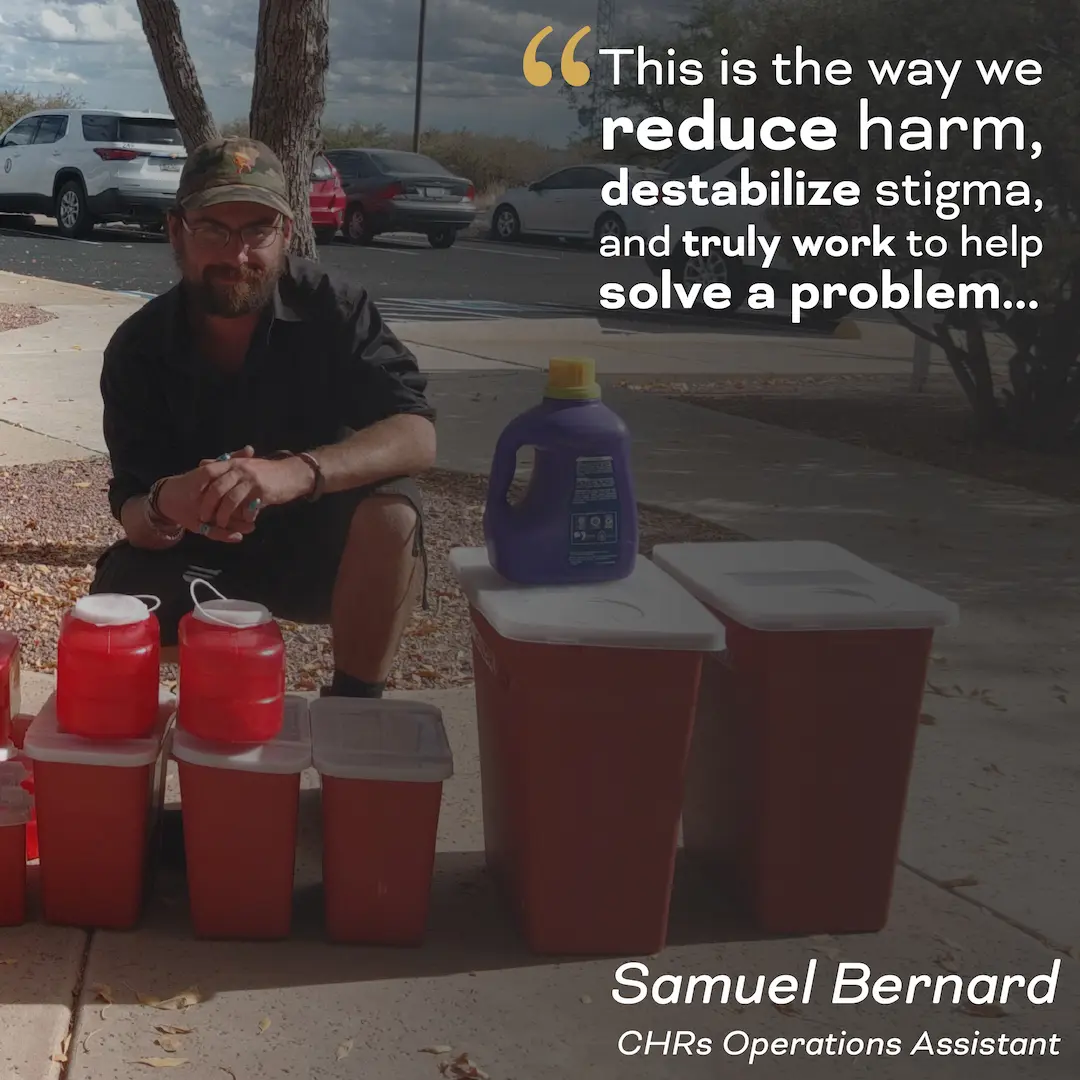
Innovative Mind, Resilient Heart: Spotlight on Samuel Bernard
For Samuel, harm reduction isn’t a concept-it’s experienced and shared in everyday life. “So to me harm reduction has been an evolving entity that has not only saved my life but has given me the opportunity to share that same incredible feeling with so many others,” he says.
Samuel first learned about harm reduction in 2022; after returning to Bisbee upon learning that his mother was dying from stage 4 cancer. “It wasn’t until after her passing and my life being thrown into a state of complete disarray that I found myself, for the first time in my life, having to sit with this overwhelming and truly gut-wrenching feeling that was not only homelessness but chaotic use and severe depression as well.”
It was in the midst of that difficult time, while staying in a shared house, harm reduction showed up for Samuel when he needed grace and compassion the most. “It was like an angel showed up in this little white ford van with not only hot food, a brand new pipe, lighters, batteries, and most importantly of all a brand new pair of Wrangler boot socks,” he describes of his first encounter with Lu Funk, CHR’s founder and executive director. “This was my first time meeting Lu and discovering what harm reduction was.”
Over the next few months, Samuel learned more about CHR’s work and helped with the organization’s move from B Street in Saginaw to our current space on Naco Highway. “After the completion of the move I was offered a position as Outreach Specialist by Lu and became a contractor working two outreach shifts a week. This role eventually became full time employment.” Samuel currently works as a rockstar multi-tasking Operations Assistant and is an integral part of CHR.
Those who work alongside him don’t hesitate to echo that sentiment. Samantha Childs calls Samuel “a rockstar” praising the energy and creativity he brings to every shift. “He shows up every day ready to go and is always working and always ready to lend a hand to his coworkers—a great team player,” she says. “His creative mind is something that makes him super‑human. Samuel is always thinking up new processes to help better support our team… His care and compassion for supporting our community seems to be his driving force.”
Ashley Iannacone adds that “it’s never a dull moment with Samuel.” Whether he’s sharing his hyper‑specific knowledge or making coworkers laugh through long days, he brings what she calls a one‑of‑a‑kind energy. “He’s a human encyclopedia,” she says. “I’m truly grateful to work alongside him and honored to call him a friend.”
Part of what makes CHR so special is being able to offer low-barrier employment and celebrating lived/living experience that is crucial to providing services and connecting with our peers. Putting this unconventional education into practice is one of the many things that qualifies Samuel for his position. “I am currently in active substance use and one of the many things CHR has done is helped me to not only better understand my relationship with my DOC (drug of choice) but has helped me also break down a lot of the stigma that is associated,”
He sees the same challenges he once faced reflected in many of CHR’s participants. “The biggest struggles when it comes to being able to get out of homelessness, is just the almost impossible task of ‘getting back to zero’ as I call it,” he explains. Meeting basic needs like food, housing, or safety can feel out of reach, and the pressure adds up quickly. “The equation becomes almost infinitely harder. I refer to this all as trying to walk a razorwire tight wire suspended between the ground and the tallest building in the world. It’s uphill and one wrong move and it’s not only back to the bottom again but each time the bottom gets deeper.”
Samuel signs off with the same openness that defines his connection to CHR; an outlook shaped by honesty, empathy, and compassion. “Thank you for taking the time to listen to what I have to say but also to help me tell my story, because this is the way that we reduce harm, destabilize stigma, and truly work to help solve a problem that we have been fighting an uphill losing battle for so long,” he shares.
His philosophy around harm reduction reveals deep roots in understanding the power of community when you feel you have nothing else to ground you. Effortlessly espousing grace and wisdom beyond his years that we should all learn from, and the idea that progress happens when we insist upon it. “Unity through sharing the trials of our adversity, not only makes us stronger but teaches us how we can best help others that are struggling around us. And to me that is the best way to promote harm reduction.”