
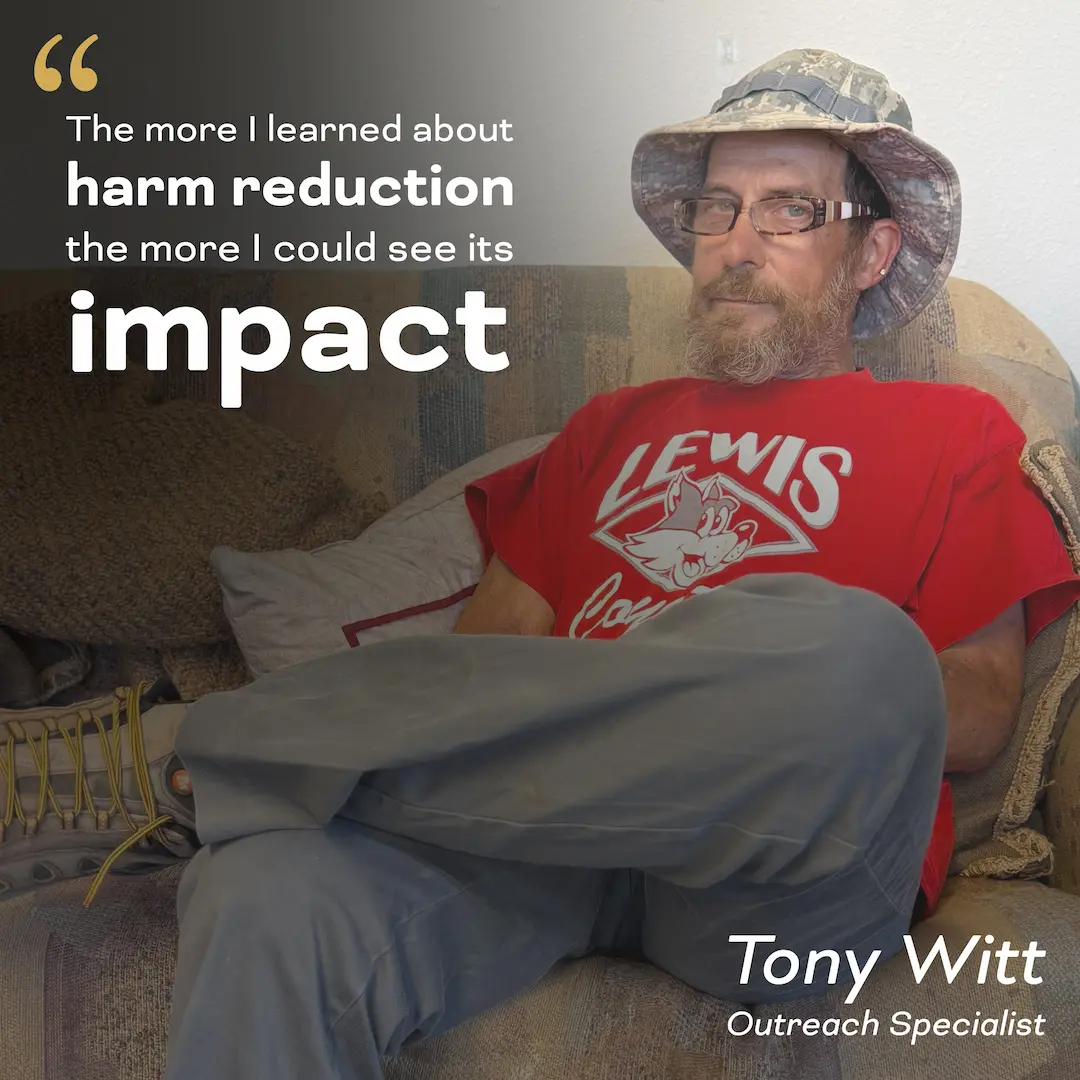
A Familiar Voice, A Deeper Impact
Tony Witt’s path to harm reduction began with witnessing a life-or-death experience that made the mission’s value unmistakable. About fifteen years ago, while he was in California, he had his first introduction to naloxone, commonly known by the brand name Narcan. “I had been homeless, in northern California, and a friend had overdosed on fentanyl,” he recalls. “There were these giant syringes with little orange cap vials that people used to bring him back. It was like a miracle to me … I didn’t understand what those were.”
After that experience, he sought out the group that had been coming around and providing support. At first, he was wary. “I was very suspicious,” he says. “Who are these people? What’s their angle? But, no, they were there purely to help.” Over time, that early suspicion gave way to gratitude and a deeper understanding of what harm reduction is and could be… and how far the work has come from a time when it was illegal, not publicly supported, and people were treated poorly for accessing help.
Years later in Bisbee, Tony met Lu, the founder of CHR, and they hit it off right away. “Lu was someone who really took the time to hear out my situation; at that time, I was grieving the loss of my brother and the consensus was they were very sincere,” he says. “I respect them greatly.” That early trust became the foundation for the role he would eventually take on at CHR as the very first Outreach Specialist in a staff position.
Tony continues to work as an Outreach Specialist, a role he describes as giving him a wide range of knowledge about what it takes to work with a diverse group of people. “Harm reduction means to me…it enables our participants to be more self-reliant,” he says. “It enables participants to use with less worry of certain communicable diseases. Addressing basic needs. While housing might be available, that doesn’t mean it is accessible to everyone. Shelters are a great example of that: they are a temporary solution to a bigger problem. Harm reduction includes housing and unbiased social support services. It’s a very wide spectrum of things that harm reduction does for our participants.” For Tony, harm reduction is practical, personal, and necessary.
That same impact is felt by the people who work alongside him. Samuel Bernard, CHR’s Operations Assistant, says, “I feel that Tony is not only a valued member of CHR, but also our community, that both his knowledge and life experiences give him valuable insight in aiding the job that we do everyday.” That combination of knowledge and lived experience, Samuel notes, is part of what makes Tony such a meaningful part of CHR’s work.
Samantha Childs, CHR’s Outreach Program Manager, says, “Tony has a way of making people feel seen. He uses his own lived experiences to build trust in a way that can’t be taught and leads every interaction with kindness, generosity, and compassion. He reminds people that they are worthy of care and respect.” For Samantha, Tony’s actions reflect the kind of community she wants to build and live in; one rooted in care, respect, and trust.
Tony sees the impact of harm reduction not just in theory, but in everyday reality. “One thing that many people don’t realize is that the use is going to happen anyways,” he says. “It’s just that along with it would come unchecked infections, disease, all the things that harm reduction does to help people.” That understanding shapes the way he approaches the work, especially in a community where stigma and resistance still create real barriers to care.
Tony also understands the weight of those barriers in a direct way. He describes how people on the streets are often dealing with sleep deprivation, lack of nutrition, constant stress, and the paranoia of being watched or judged. Tony knows how those conditions take a serious toll on people’s mental and physical well-being, and how the addition of stigma exacerbates it all. “Stigma towards the unhoused and people who use drugs is the greatest barrier,” he says. The work of harm reduction is not only about supplies or services, but about meeting people in the middle of those conditions with consistency and care.
What Tony values most about CHR is the way the organization has grown without losing its heart. He describes the staff as down to earth and says the organization still feels like family. When asked what has changed at CHR since he joined, Tony is in awe of the evolution. “Everything… having left and come back to see the tremendous growth of the organization and staff it is good to see the one-on-one attention given to participants has not changed and the intention in the program remains the same,” he says. For him, that continuity matters as much, if not more, than the growth itself.
At the same time, Tony is clear-eyed about the challenges harm reduction faces. He points to the current political climate, the curbs on federal grants, and the stigma directed at harm reduction groups and people in transition. “I think it’s more important than ever that there’s room, in any capacity, for a group like this,” he says. “The more infrastructure we have for alternative methods of care, the better off we’re going to be.” His perspective is grounded in experience, but also in hope that the work can keep expanding even when the environment around it is difficult.
Tony’s story is one of trust earned by action and lasting commitment. He discovered harm reduction by helping a dear friend survive, and now helps carry that same support forward for others. He leaves us with some food for thought: “In a perfect world harm reduction would cease to exist, because people would be treated fairly and equity would be alive and well. Until then, I’ll continue to be the person who takes the equitable approach.”