
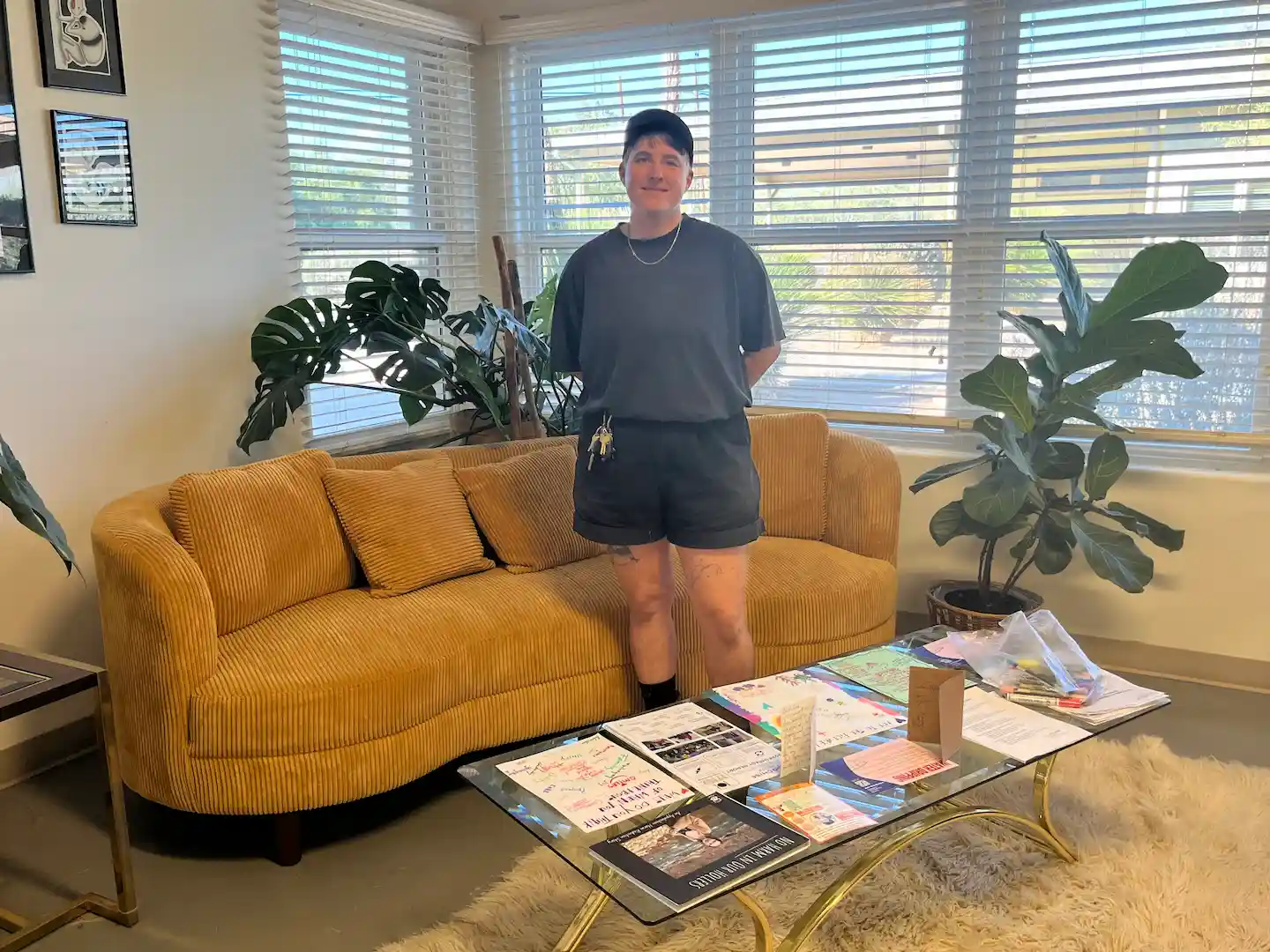
Good things happen to people with good hearts. Lu Funk, founder of Cochise Harm Reduction, a grassroots mutual aid-based nonprofit organization focused on improving the lives of people who use drugs in rural communities, is one of those people.
Based out of Olympia, Washington for 11 years before traveling the roads and railways of the West for a few years, Funk ended up in Bisbee for a weekend with friends from Tucson. “I showed up and got sucked in,” said Funk. “Everything eventually landed here for me.”
The primary reason Funk’s friends wanted to come to town is to study with an herbalist, Mimi Kamp, and Funk’s own long-term recovery included herbalism. Funk ended up staying in Bisbee and working for Kamp, taking care of her land. The years of road traveling came to an end, planting seeds in a rural community waiting for their arrival.
In addition to learning more about herbalism, Funk was drawn to Chico MacMurtrie’s “robotic ranch,” a place to practice robotic art installation-a style of art that uses automated or robotic technology, many times programmed to interact with the immediate environment. “I had a cool art gig and herbs,” said Funk. “How could
I turn it down?”
In 2018, the path would eventually lead Funk to Dan Maldonado’s doorstep at Goar Park Lunches, handing out NARCAN, an over-the-counter nasal spray that can save a life in an opioid emergency. What started as community service for a prior drug charge led to the launching of Cochise Harm Reduction.
Funk founded the 501(c)(3) nonprofit organization in 2019,without any experience working at or running one. It’s been a huge crash course in running a business and a nonprofit,” said Funk. “The easy part for me was helping people. That’s always been in my blood.”
And what started as Funk delivering food and supplies in their partner’s van, has grown into having a physical office- with desks, couches, computers and all- with a staff of 10, who all have their connection to/experience with drug use.
What Funk realized early in the pandemic was they had to meet people where they were at, as those in the community who depended on them couldn’t physically get to them. So, they would deliver the Goar Park Lunches meals as well as harm reduction supplies to those who needed the services in the area.
During that time, Funk also started writing grants and found it fulfilling; they had never imagined they’d be running a 501(c)(3). There was a lot of money being given away in grants at that time,” said Funk. “Everything snowballed from there.” No one had traversed this course of instilling a harm reduction program to rural communities; they are defining what it looks like, and county and state health departments in Arizona have taken notice. In 2021, Cochise County Health & Social Services offered Funk a contract to replicate what they did for their syringe exchange program.
Before a law was passed to make a program like this legal, it all had to happen underground. The partnership continues to be beneficial for all parties, with the county health department being one of the nonprofit’s biggest funders.
Arizona Department of Health Services has also become a key funder, with money coming from both the county and state through the Justice Reinvestment Fund, established by the Smart and Safe Arizona Act passed in 2020. The fund receives 10% of the state’s excise tax revenue from recreational marijuana sales to provide grants to qualified nonprofits and public health departments. “It gives back to local communities,” said Funk.
Funk started the nonprofit through writing grants, and they continue to write all the grants for the organization. Fortunately, Cochise Harm Reduction is at a point where they do not have to stress about where the next round of funding will come from, having fewer but larger grants now.
That means Funk can pivot to other projects, namely education and replication in the rural communities in this region (and beyond). Funk wants to focus on teaching as a way for others in the same situation and facing the same challenges to use their established playbook, stressing the importance of delivering services in a different way to people who cannot physically access the services.
One way the nonprofit shows up for the community is through their weekly resource center setup every Thursday afternoon in Brewery Gulch, right under City Park. They offer harm reduction supplies, food, and a peer support specialist, and it is open to all at no cost.
To learn more about the nonprofit or to donate, visit cochiseharmreduction.org. The immediate need, with a change of season right around the corner, is winter hats, boots, shoes, gloves or mittens, coats or jackets, blankets, sleeping bags, tents, and nonperishable items—anything to keep people living outside warm and fed during the colder months. Donations are accepted at their office, located at 1556 S Naco Highway, Building B